RevisionHub

Third Form Computer Science β€” enter the class password

Topic 1.2.3

Units

How do you want to revise this topic today?
πŸ“–
Read & Recall
You will begin by reading the information sheet carefully to build your understanding of the topic. This matters because learning is strengthened when you make your brain work to remember information rather than just re-reading it. Finally, you will check to identify anything you missed or misunderstood, helping you correct and improve your knowledge.
1
Answer warm-up questions from memory
2
Read the sheet + ask the AI tutor as you go
3
Cover it β€” write down everything you remember
4
Quiz or flashcards to find your gaps
5
Practise real exam questions
6
Reinforce with audio, video & more
🎧
Watch & Listen
You will start by watching or listening to an explanation to help you understand the topic. You will then recall what you can remember. This step is important because trying to remember from memory strengthens learning and highlights what you do and do not yet know. You will then complete tasks to check accuracy, fill gaps, and improve your understanding.
1
Answer warm-up questions out loud
2
Listen to the podcast
3
Watch the video β€” sheet open as visual anchor
4
Say or draw everything you remember
5
Quiz or flashcards to find your gaps
6
Practise real exam questions

There's no wrong choice β€” you can switch at any time.

πŸŽ‰
Session complete β€” well done.
Come back in 3 days for your first spaced review.
🧠
Answer these questions β€” without looking anything up 3 minβœ“
This warms up your memory and shows you what to focus on.
β–Ύ
What to do Write down whatever you know β€” even a guess. If you have no idea, write "not sure". Do not skip this step. Students who attempt questions before studying remember significantly more afterwards.
Question 1 of 3

What is a bit?

Question 2 of 3

How many bits are in a byte?

Question 3 of 3

Put these units in order from smallest to largest: gigabyte, kilobyte, megabyte, terabyte.

Don't worry about being right β€” you're about to learn all of this.

πŸ“–
Read the information sheet & ask questions as you go 10–15 min βœ“
Read the sheet and use the AI tutor alongside it to ask about anything you don't understand.
β–Ύ
How to use this Work through the information sheet one section at a time. After each section, ask yourself "did I understand all of that?" If not, open the Mindjoy AI Tutor using the link below β€” sign in, then keep it open in a split screen alongside this page so you can ask questions as you go.
πŸ“„
Information sheet
Units
πŸ“„
Units
View the information sheet to read through the topic
How to read it
β†’ Read one colour section at a time
β†’ After each section, look away and say what you just read
β†’ If you can't remember it, re-read that section only
β†’ Confused by something? Ask the AI tutor β†’
πŸ’¬
Mindjoy AI Tutor
Ask anything about this topic while you read
Example questions you could ask
Why do computers use binary? How do you convert between units? What is a nibble? Why is 1 kilobyte not exactly 1000 bytes?
AI Tutor
Hi! I'm here while you read. Ask me anything β€” there are no silly questions. Just type what's confusing you.
You
Why do computers use binary?
AI Tutor
Great question! Open the Mindjoy AI Tutor to get a personalised answer about this topic.
✍️
Close the sheet. Write down everything you remember. 5 minβœ“
This is the most important step. Do not skip it.
β–Ύ
Do this exactly, in this order This is called Look β†’ Cover β†’ Recall β†’ Check. The uncomfortable feeling of not being able to remember is your memory being strengthened β€” not a sign you're bad at this.
β‘ 

Close the information sheet. Do not look at it.

β‘‘

Get a blank piece of paper. Write everything you can remember β€” headings, facts, definitions, anything.

β‘’

When you get stuck, keep trying. Do not open the sheet yet. Push through for at least 3 minutes.

β‘£

Now open the sheet and check. Circle everything you missed. These are your gaps.

🎯
Test yourself β€” quiz or flashcards 5 minβœ“
Choose whichever works best for you. Both will show you exactly what to go back and revise.
β–Ύ
Pick one (or do both!) Take the Mindjoy quiz for quick-fire questions with instant feedback, or use the flashcards to test yourself one concept at a time. After either, go back and revise any topics you got wrong.
πŸ€–
Take the Mindjoy quiz
Quick-fire questions with feedback
πŸ“
Practise real exam questions 8 minβœ“
Answer in full sentences. Read the feedback carefully.
β–Ύ
How to get the most from this Head to Smart Revise and select your topic. Answer the exam questions in full sentences, using technical vocabulary where you can. Read the feedback carefully β€” it will highlight exactly what you need to improve.
✨
Reinforce with audio, video & more β€” whenever suits you Wheneverβœ“
Extra resources to strengthen what you've learned. Use them anytime.
β–Ύ
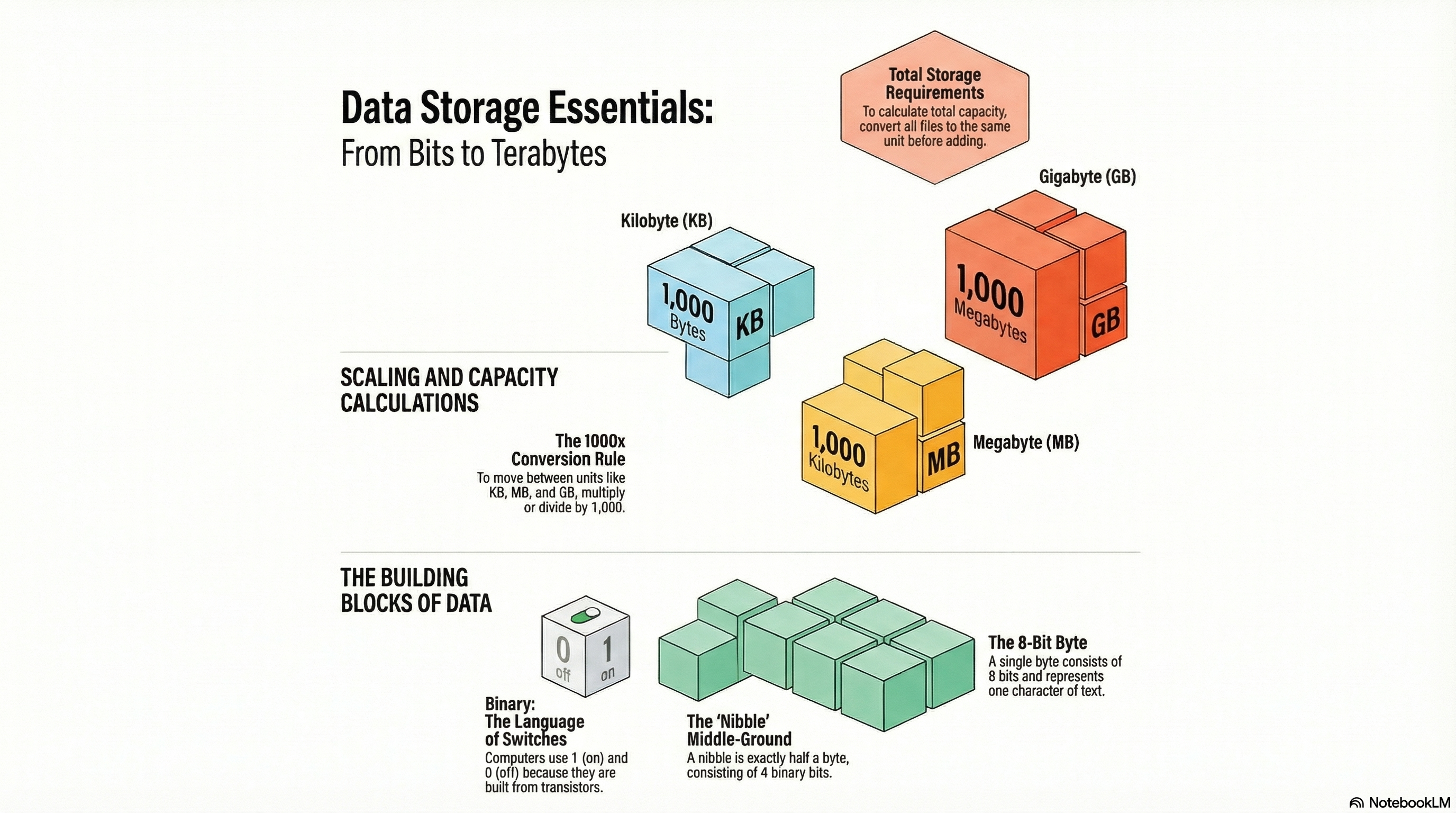
These are for reinforcement Listen to the podcast on the way to school. Watch the video before bed. Look over the infographic to refresh the key points. No notes needed β€” just notice how much you recognise now.

🎧 Podcast

🎬 Video

πŸ“Š Infographic

Units infographic

πŸ“‘ Slides

πŸ“…
Come back to this topic on these dates
Spaced review at increasing intervals is one of the most effective things you can do for long-term memory.
Review 1 Β· in 3 days Review 2 Β· in 1 week Review 3 Β· in 2 weeks Review 4 Β· before exam
πŸ’­
Answer these questions β€” say your answers out loud 3 minβœ“
You don't need to write anything. Just speak your answer.
β–Ύ
What to do Read each question, then say your answer out loud. If you have no idea, say "not sure" and move on. This warms up your memory before you hear the content.
Question 1 of 3 β€” say your answer out loud

What is a bit?

Question 2 of 3 β€” say your answer out loud

How many bits are in a byte?

Question 3 of 3 β€” say your answer out loud

Put these units in order from smallest to largest: gigabyte, kilobyte, megabyte, terabyte.

Don't worry about being right β€” you're about to hear all of this.

🎧
Listen to the podcast ~10 minβœ“
Listen with headphones. Full attention β€” this is your main way of learning the content.
β–Ύ
How to listen β€” this is not background music Headphones on. Phone face-down. Just listen for the full duration. As you hear each topic, try to picture it. Sit for 30 seconds at the end and think about what you heard.
🎬
Watch the video β€” with the information sheet open beside it ~7 minβœ“
Use the sheet as a visual anchor β€” find each topic as you hear it mentioned.
β–Ύ
What to do Open the information sheet alongside the video. As each topic is covered, find it on the sheet and look at it β€” the diagram, the colour section, the key words. You're pairing what you hear with what you see. If something doesn't make sense, ask the AI tutor.
πŸ—£οΈ
Close everything. Say or draw what you remember. 5 minβœ“
This is the most important step. You do not need to write a single word.
β–Ύ
Do one of these β€” pick whichever feels right Speaking and drawing work just as well as writing. The point is to retrieve from memory β€” not to copy from somewhere.
β‘ 

Close everything first. No sheet, no video, no podcast.

β‘‘

Talk it out. Explain the topic out loud as if teaching it. Record yourself if that helps.

β‘’

Or draw it out. Sketch a diagram from memory. No labels needed β€” just from memory.

β‘£

Now check. Open the information sheet. What did you miss? Look at those gaps for 60 seconds.

🎯
Test yourself β€” quiz or flashcards 5 minβœ“
Choose whichever works best for you. Both will show you exactly what to go back and revise.
β–Ύ
Pick one (or do both!) Take the Mindjoy quiz for quick-fire questions with instant feedback, or use the flashcards to test yourself one concept at a time. After either, go back and revise any topics you got wrong.
πŸ€–
Take the Mindjoy quiz
Quick-fire questions with feedback
πŸ“
Practise real exam questions 8 minβœ“
Answer in full sentences. Read the feedback carefully.
β–Ύ
How to get the most from this Head to Smart Revise and select your topic. Answer the exam questions in full sentences, using technical vocabulary where you can. Read the feedback carefully β€” it will highlight exactly what you need to improve.
πŸ“…
Come back to this topic on these dates
Spaced review at increasing intervals is one of the most effective things you can do for long-term memory.
Review 1 Β· in 3 days Review 2 Β· in 1 week Review 3 Β· in 2 weeks Review 4 Β· before exam